

Blog
Why do some people produce “pasty meibum?”
Why do some people produce “pasty meibum?” (A Root Cause of MGD that looks like strings of toothpaste or spaghetti - rather than thin, clear oil when expressed from these oil glands. This “clogs” the glands and creates obstruction.)
Some years ago, I was asked by a colleague about why some people produce “pasty meibum.” I wrote a long diatribe and when I saw a related question recently, I dug this answer up and thought I’d share.
Part 1:
Some of my answers would be somewhat modified today. (As most of you know, I’ve published on off label use of RF (radiofrequency) over Lipiflow and for addressing conjunctivochalasis, Zocuwipes over TTO related cleaning and Maxitears over other oils supplements - FD, consulting RF companies, part owner of the eyeThera company that makes the shields I use for RF expression and consultant to the Zocular company making the Zocuwipes).
My 4-part answer attempts to address that million-dollar question.
The Tear Science folks (initially headed by Drs. D. Korb, C. Blackie, et al - but now owned and operated by J&J) would include poor (partial) blinking in that answer, as that appears to be a major cause of stagnation of the oil producing eyelid glands (MGs). When stagnant oil becomes exposed to air, salts and the acidic breakdown products of bacteria and their oil-digesting lipases - it turns to soap and solidifies. Where normal MG (Meibomian Gland) oils are liquid at body temperatures, these harder oily complexes become wax-like and block the glands. The back-pressure appears to induce withering (or else they go on to produce styes). Of some interest is Dr. Korb’s finding that the temperature of the eyelids in patients with Meibomian (oil) Gland Dysfunction (MGD) is "colder" than those who don't have MGD. As far as I know, no one has been able to explain this phenomenon (though Dr. Korb points out that athletes have higher lid temperatures and appear less prone to this disease), but lower temperatures would also lead to solidification and blockage. Dr. Korb demonstrated to me the capillary attraction produced by the lids as they separate after a full blink. This engages the oil squeezed out by the action of the lids coming together with enough pressure to dispense micro-droplets onto the lid margin. Tiny vertical indentations in the lid margin assist in this backward and upward movement of oil - unless a waxy varnish obliterates these little "riverbeds" and occludes the openings. This is one reason I like to “debride” (scrape off) this waxy varnish as a part of my dry eye exam as it aids my diagnosis and may help in treatment of some with serviceable glands that are otherwise “dysfunctioning.”
Part 2 addresses other sources for tear oils and digs into what these oils are.
Doctor, I have a bright red spot on my eye! What do I do now (about a subconjunctival hemorrhage)?
PART 2
Once a blood vessel breaks, the short-term “fix” to limit blood flowing out and “bruising” the white of the eye, is anything that constricts the vessel (so it is letting less blood out).
- Cold is a good constrictor – so a cold compress over the lids.
- Ironically, drops like Lumify (but see above on this).
- Lubrication of the surface, so preservative free artificial tears.
- Light pressure (assuming you can press on the point where the blood is leaking from).
- Avoiding blood thinners (if the bruise feels uncomfortable, taking aspirin, Advil, Aleve or any other blood thinning products – too numerous to list here – will cause blood not to clot and allow for a larger bruise).
- Controlling blood pressure (so poorly controlled blood pressure will force more blood out of the broken vessel). Worry over the bruise might stir up the blood pressure, so try to relax.
My usual advice to a patient with a bright red spot on the white of their eye is –
- Unless there is undue pain, decreased vision or recent surgery on their eye - to relax (& generally – they don’t need to rush in for an eye exam or treatment)
- Stop blood thinners like oral oil supplements for a few days, aspirin (or other blood thinners – UNLESS prescribed by their primary care or heart doctor – then check with them first). Holding strong spices, exercise, and alcohol for a few days as this also helps reduce blood vessel dilation and reduces blood flowing out of the blood vessel.
- If the “bruise” is particularly unsightly, consider wearing an eye shield (or sleep goggles) at night so you are less likely to rub it or press it directly against a pillow in a way that might re-injure the broken vessel. Don’t rub your eye!
- Keep preservative-free artificial tears in the refrigerator and use them every few minutes as soon as you recognize the broken vessel. Once it is clearly not “growing,” then reduce the applications to hourly or less. The direct “cold” will constrict the vessel and sooth the irritation. The lubrication will reduce the friction. If you have a “eye whitening eyedrop” (Like Lumify) on hand, this could be one of the few times it is worth using it in a medical way – but sparingly and only for a day or two, to help stabilize the blood vessel and the clot that stops it from oozing.
- If you recognize it the moment it happens (which is sometimes possible), then closing the lids and gently pressing over that part of the lid covering the area of bruising may help. Unfortunately, if you look around while doing this, then you may be rubbing over the vessel in a way that pumps more blood out – so keeping your eye closed and not moving your eye - while gently pressing for 30 seconds on and 10 seconds off - for a few minutes may help. Using a covered piece of ice to apply the pressure can be somewhat more helpful. After the first 24 hours, ice and cold is generally only useful for comfort and not useful to prevent further bruising.
- If you are doing heavy lifting, coughing, sneezing, straining at bowel movements or vomiting, then the sudden rise in Blood Pressure can “blow out” a blood vessel – and those on the white of your eye are the more “visible.” Controlling BP has already been discussed and holding back on heavy lifting while healing the broken vessel can help. If the coughing is related to a cold or allergies and/or the sneezing is allergic, then something to reduce allergies and coughing can help. Stool softeners, laxatives and a healthy diet can help with straining. Vomiting, if ongoing, may be worth reaching out to your primary care doctor for an “anti-emetic” (a medicine to reduce vomiting).
- If your eye doctor has recommended hot compresses, it is usually best to hold off for 5 days (allowing enough time for healing the vessel before dilating from the heat).
- If your doctor has prescribed a steroid drop for your inflammation, then continuing that drop while nursing the broken blood vessel is worthwhile, as stopping the steroid risks rebound redness. The dilation of the vessels associated with rebound inflammation will cause the broken vessel to also dilate – and possibly to blow out the small clot that stopped the bleeding and allow more bleeding (and bruising) under that clear membrane we call the conjunctiva.
- Most important – report these events to your dry eye specialist so they know this is going on. They usually will recommend treatments designed to improve your ability to produce more – and better – tears to aid in natural lubrication and in the support of the living surface of your eyes. If the conjunctiva has too much laxity and it is apparent that these loose folds are contributing to the breaking of these vessels (& can commonly contribute to dry eye symptoms – see my earlier posts on this) – then they may recommend a surgical repair (I’ve posted on simple plications). Working with a good dry eye specialist is important to all eye health!
Doctor, I have a bright red spot on my eye! What caused it, is it dangerous and what do I do now (about a subconjunctival hemorrhage)?
Broken blood vessels are a commonplace problem all over our bodies - resulting in what we commonly call a bruise. Generally they are not dangerous (though like most things - they can range in cause and in degree.) In rare cases they can be dangerous - so always report them to your eye care provider and call at once if there is significant pain, if they appear in the context of an eye injury or recent eye surgery or are associated with any loss of vision.
Understanding why a blood vessel breaks in the thin, clear, membrane we call the conjunctiva, (what we call a subconjunctival hemorrhage), means also understanding the membrane and the blood vessels in it. There are also several main functions of this membrane that speak to the dry eye issue that don’t directly relate to broken blood vessels but are also key to how we approach overly dilated and breaking blood vessels.
This “saran wrap-like” membrane we call the conjunctiva is supposed to be smooth, moist, clear and “shrink-wrapped” over the underlying white part of the eye (sclera) and over the inner sides of the eyelids. This provides for a smooth, even, and effortless squeegee of the lids, as they go back and forth over the clear “window” (cornea) we see through. It contains cells and tiny glands that make the proteins and some of the moisture that forms the tears that wash over the cornea. It also acts as the “lymph node” of the eye, containing the important defense cells that protect our eyes from pollution, infection and cancers that could come from sun exposure. It is the job of the blood vessels to supply the red blood support for this membrane, so it can do all these jobs.
Irritation – from pollution, infection, injury, allergies, friction – and sadly, yes - DRYNESS – all conspire to create inflammation – our body’s reaction to irritation. This leads to dilation of the blood vessels so that they can deliver more support to the membrane (conjunctiva) – so it can better do its many jobs. This makes the eye look “red” (from the bigger blood vessels carrying the red blood). This pattern is typically red-pencil web-like, as opposed to the broader strokes of red from broken blood vessels. The larger the blood vessel when it breaks, the larger the broad strokes of red from these “hemorrhages” – creating visible bruising.
Without getting too deep into all the sources of inflammation, I can only touch on the many risk factors for breaking blood vessels in the conjunctiva and I’ll stay focused on the common dry eye-related issues. Friction is a common one, as lack of tears – and most frequently, lack of tear oils, leads to more “drag” over the membrane as it tries to “hug” the support underneath. This support over the white of the eye is a fibrous “glue” that functions a bit like living Velcro (Tenon’s tissue). Friction breaks down the fibers and their glue – so the membrane comes loose (conjunctivochalasis – spelled many ways - please see my earlier posts on this). These pleats and folds twist and turn with blinking or from finger rubbing – and the “shearing forces” tear at the blood vessels. The dryness leading up to this can lead to increasing dilation of the blood vessels – so when they tear open, they can spill more blood than thin ones. Anything that causes irritation will lead to inflammation and to growing larger, redder blood vessels (so they can better do their job of supporting the effort of healing, defending, and otherwise taking care of the health of our eyes).
When you apply “vasoconstrictors” (like Lumify, Visine for red eyes, or other eye whitening over the counter products), these drops cause the muscles in the blood vessels to “squeeze” and choke down the blood flow. Less blood means less redness – the point of the eye “whitener.” The longer-term problem with this is several fold:
- these drops themselves contain preservatives – the harsh, toxic chemicals designed to prevent green fuzzy stuff from growing inside the bottle you apply it with. This “hurts” the eye and triggers more inflammation.
- the “squeezing” of the muscles leads to muscle fatigue. When the muscles “relax” the vessels become bigger, because with relaxation of the squeezing muscles, the blood vessel dilates (and carries more blood) – so looks redder – causing a desire to use more of the drops.
- with sustained use, there is a more rapid “wearing off” (tachyphylaxis), so the ability of the drop to do its job becomes less. This leads to a cycle of drop applications where the only winner is the company selling you those drops.
To fight inflammation, we use “anti-inflammatories” – medicines designed to calm the defenses down and allow the blood vessels to return to a more normal state (I have more comprehensive, earlier posts on this). In a healthy eye, these vessels are so small as to be nearly invisible to the casual observer (hence the “white” eyes). The more irritated the eyes are, the redder they become and the stronger the “anti-inflammatory” medication needs to be to counteract the redness (and quite the eye down). Strongest anti-inflammatories are the steroids like difluprednate, prednisone and dexamethasone. Weakest are the Cyclosporine (Restasis, Cequa and the like) and Lifitegrast (Xiidra) groups as well as the non-steroidals similar to aspirin (Advil, Aleve and the like).
The problem with all of these is that unless you are also dealing with the source of inflammation (whatever irritation is triggering it), then this is a Band-Aid approach. As soon as you back off on the anti-inflammatory medication, then the redness tends to bounce right back. Cauterizing blood vessels is a stronger way to curb them – but again, unless you deal with what brought them along to be big, red, angry-looking vessels, then they tend to grow back with a vengeance (because now you’ve really irritated that surface by damaging it, and the blood vessels are what help it to heal).
Long-term use of steroids can thin membranes and blood vessels, making them more fragile. Anything that thins blood (including all aspirin-like products as well as a bevy of other prescriptive and over the counter supplements, medication and even foods and oils) will mean larger bruises and red spots, too.
Finding the undercurrent of irritation and dealing with it directly will usually lead to the best “cure” for redness. Sometimes this is an autoimmune problem. Sometimes it is an allergy or some chronic toxic exposure (like the preservatives in the whiteners – and sadly also the steroids. Fortunately, the cyclosporine and lifitegrast products do not). Sometimes it is from incomplete restoration of the tears and ongoing dryness. The total number of causes of inflammation is a very long list, best sorted out by your dry eye specialist and any team required to turn over every stone and leaf. This means that until every aspect of irritation leading to redness is addressed, then it is hard to effectively reduce that redness. As long as there is friction, irritation and inflammation, this is an uphill battle.
My next post will cover the “what to do’s” when these bruises happen on the white of your eye.
Problems with use and proper care of a Bruder (or similar) moist heat eyelid mask.
As a dry eye specialist who recommends the Bruder masks to my dry eye patients, I like their simplicity, low cost and ease of use. I’ve posted on use of hot, moist compresses before, so this post is more about the Bruder-style mask. I’ve had a few returns for a mask that opens up and bleeds beads in the microwave. There are a few reliable causes, though some do seem to occur spontaneously (most seem to last at least a year or longer with regular use and adequate care).
A few caveats:
- If you wear makeup (especially mascara and/or lid liner), some products contain metals (to give more visual “pop”). Any metal on the mask that goes in the microwave will cause arcing and burn the mask (leaving little or bigger “burn holes” the beads can escape through). Always remove makeup thoroughly before using the mask - or at least use a tissue (or the more expensive disposable covers sold by Bruder and others) to cover the mask when you use it.
- you can gently clean the mask with soapy water and rinse well. Let it fully dry (about a day) before microwaving it again.
- when you have it on for a few minutes and your lids are sufficiently hot, try doing “eyelid crunches” (my term for intermittently squeezing the lids moderately strongly together and then releasing the tension. I find a slow count of “3” on and off squeezing is sufficient if done for a minute or two while the lids are sufficiently warm). This promotes moving the oils that were once cold, thick and “hard” through and out of the glands while the oil is thin and more able to move through the glands.
- avoid heavy pressure over the mask. Light contact with the lids is favored but higher pressure also can put pressure on the eyeballs under the lids (which can raise your eye pressure - not good if you are prone to glaucoma).
- you are likely to notice a feeling of greasy oil in your eyes (that can also be somewhat blurring) for several minutes after you remove the mask (especially if you’ve expelled a good dose of waxy oils).
As usual, consult your dry eye specialist for proper care of your particular condition.
How do everyday products affect our eyes?
When I see patients with complex problems like dry eye disease, allergies or eyelid skin problems (which are often all interrelated), one of the questions that I ask is - what products do you use in or around your eyes? For everyone, this can include contact lenses and the solutions used to clean, disinfect and moisturize them (see my earlier post on that). Various prescriptive and over the counter eye drops gels and ointments are another group. For most, this can also include skin cleansers, moisturizers or sun-blocking creams. This time of year (being the day before Halloween) it might include face paint or theater glues to apply false moustaches and beards. Colored costume contact lenses. For women, this frequently includes various forms of daily makeup, lid liners, mascara and eyelash extensions - yet all of these products may contribute to the eye problems they present with.
There are many posts (mine and others) denouncing “bad products” and I point out to my patients that in the USA, there is little governance overseeing producers of makeup (EWG offers free online information and is one of a few online consumer protection groups that target makeup and other everyday products that can be bad for you. I quote from some of their online information found here: https://www.ewg.org/news-insights/news/2021/08/protecting-consumers-toxics-cosmetics-us-lags-least-80-countries ). In some countries there are over 1600 ingredients banned from makeup as opposed to just 9 banned by the FDA from makeup for safety concerns and 80 countries lead us (in the USA) in banning harmful chemicals in makeup products.
Once this information is absorbed by our brains, we might pooh pooh it by thinking “my products are:” “all natural” or “organic” or “vegan” or on the label it says “doctor tested and doctor approved.” But what does this really mean? In the USA, it usually doesn’t mean much, since there is so. little oversight to hold these companies accountable - and just because the company has a “big name” or “great reputation” (as in “even my grandmother used this stuff” and “all my friends say it’s great”) - unfortunately these statements can all be false or misleading.
A young patient of mine was recently referred because she had severe scarring of her corneas that was an imminent threat to her vision. She was studying about cosmetics and wore eyelash extensions - which looked great - but her mother stated that her eyes were “blood red” for several hours each time she had them applied. She wore contact lenses that were cleaned daily in an “all purpose” solution and she had makeup on that raised more concerns. Basically, each of these alone might cause a problem like hers, but together, were likely the “perfect storm” to cause this eyesight-threatening scarring. Add to that the usual dry eye problems common to all school-aged children and young adults (again see my earlier posts) - and she was in grave dangers that may haunt her the rest of her (likely long) life.
Why is it so hard to protect people from unscrupulous companies that use toxins in their products and then prey on the public when they hard-sell those products to us? The answer goes beyond the weakness of our political leaders (though this is an obvious start to the fix). As long as corporate dollars can sway the politicians elected by us to protect us, I think we can be sure that our best interests are not sufficiently protected. But that is not the whole answer. Unfortunately once you start adding chemicals and their compounds to other chemicals, the resulting mix can become much better - or much worse - as sum of their parts - than any one or two taken alone or together. This concept was put most articulately in digital ink by my friend, brilliant colleague and lid hygiene product inventor, Peter Pham, MD. Dr. Pham is the inventor or the Zocular lid care products I’ve recommended for years to my patients. He majored in chemistry before going on to his MD degree and then to a career in ophthalmology where he practices in Texas. His recent post to a group of dry eye doctors is quoted here:
“The ingredient list is a whole lot more than the sum of its parts. It's too confusing to try to deduce "goodness" or "badness" from any individual ingredient. A better approach is to understand the purpose of an ingredient or set of ingredients. Is it there to emulsify? Chelate metal ions? Balance pH? Provide bulk? If an ingredient serves a purpose, it's less likely to cause harm - if we grasp the steering wheel with both hands, it's hard to punch our passengers. Similarly, if a hydroxyl group forms hydrogen bonding to another compound, it can't chase a different compound. Chemicals, like hands, can be used to harm or help. Attempts to avoid certain chemicals often abolishes entire classes of molecules that can actually help our patients, and alternatives that appear more organic or pure can have unexpected, unknown properties since there's little data or experience with newer compounds. As an example, EWG classifies behenyl behenate as a safe "1" even though there's no data to support or refute this. As another example, many blogs suggest "alcohols" should be avoided in a formulation with little discussion about the nuances of "alcohol". This would basically remove classes of alcohols that moisturize, preserve, emulsify, etc. And includes one that intoxicates, which feeds into our fear of "alcohol". If it fries our brain with just a few sips, what would it do to our eyes!
To add to the complexity of trying to divine poison or cure from an ingredient list, the list itself is only a partial list of ingredients since many of the listed ingredients have its own set of ingredients that aren't listed. As an example, most surfactants come as a liquid concentrate. This concentrate has its own list of ingredients - stabilizers, preservatives, etc. Listing the ingredients within ingredients of ingredients would make a novel and add little to our ability to predict or understand a formulation.
There is no risk-free activity in life. The very oxygen that gives us life will lead to our demise through secondary oxidative processes. But we should avoid obvious dangers like putting microscopic arrows in a formulation like Laura M Periman said.”
So should we just give up and let the free market determine what products we use? My answer is a hard “NO” and is based on almost 40 years of clinical practice and training. I advocate that we educate ourselves on what is generally known (using apps like “EWG” and “Think Dirty, Shop Clean” - however imperfect they may be), that we listen to the advice of those more medically knowledgeable, like our dry eye specialists and dermatologists and we invest public dollars into research so we can better learn the nuances of how safe or how risky these daily products can be. Meanwhile, use caution and remember that beauty is in the eyes of the beholder. We all have an inner beauty that can be revealed through our actions - and does not necessarily require products to hide what we perceive to be imperfections. Stay safe.
What’s new in treating Blepharitis?
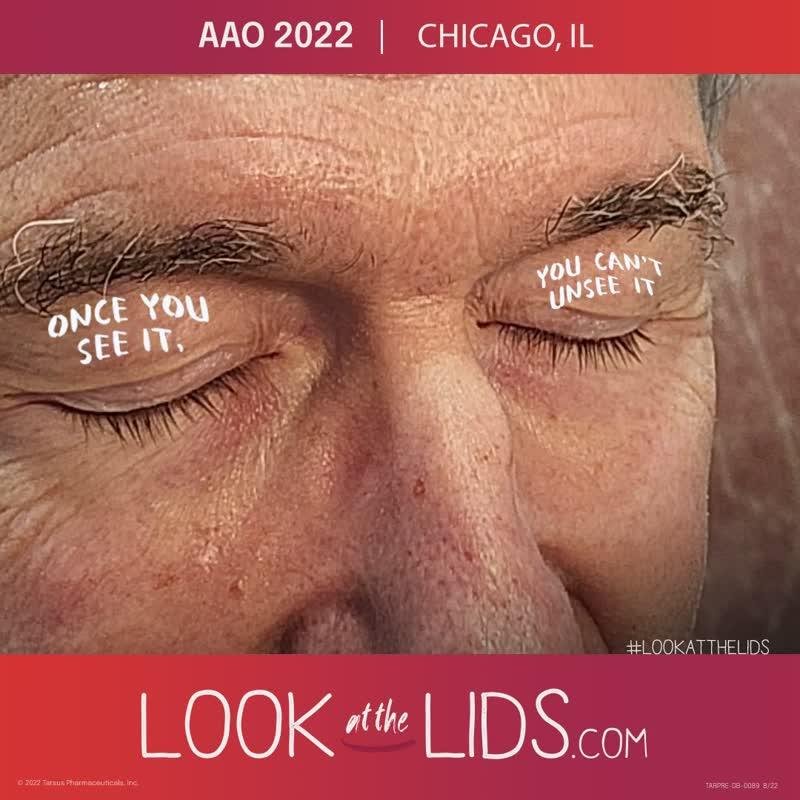
During my time at the national eye meeting in Chicago earlier this month, there was a big focus on a new treatment for Demodex-related blepharitis. At the booth representing Tarsus - the company making this new treatment medication, they offered to take pictures of attendees - so I naturally volunteered. Yes, the awful photo of my face titled “AAO 2022 / Chicago, IL” is what you see below. Fortunately, my eyelids looked quite clean (thanks to my daily routine of Zocuwipes and Avenova lid hygiene - I’ve posted on this earlier) - though my face shows off my significant rosacea, fine lines and extra skin - called dermatochalasis - which basically means I’m overdue for my IPL and RadioFrequency lid treatments.
The photo beneath my photo is of a patient’s eyelids that I took through the eyepiece of my office slitlamp (a kind of microscope we eye doctors use to help us examine our eye patients). That poor patient has a lot of blepharitis - and the waxy “collars” around the base of the lashes illustrates the typical finding we see in eyelids that are “colonized” (in this case, overrun) with Demodex - the tiny skin mite that commonly lives in and around eyelashes. They subsist off eyelid oils and germs that live off our tears. Unfortunately, they are quite prevalent (if you go by age, the likelihood that you will carry these mites goes up approximately 10% per decade - so by age 50, you have a 50:50 chance you have them - and by that equation, by age 100, you would be certain to have them) - but as with all statistics - it only matters if it affects you.
If you have these mites - and if you have resistant skin, then you may not know you have them - you might not care - and it might not matter. However, if you have sensitive skin (common in ocular rosacea, like I have), then the life cycle (which I won’t get into, as it would likely keep you up all night like a bad horror movie) is likely to be like adding gasoline to a flame. This causes irritation that leads to inflammation that fans the flames of dry eye disease. Tarsus is repurposing a veterinarian medicine (used to treat dog’s mange) as this medicine has proven extremely effective at knocking off this mite without irritating human eyes or eyelids. Sadly, it is likely to take months (and could be closer to a year) before it passes through the hoops of the FDA and becomes something we eye doctors can prescribe for our patients.
The good news is that there are many treatment options that are already available and can be quite effective. In fact, the BlephEx and ZEST treatments many dry eye specialists use, coupled with ongoing Zocuwipe (or some Tea Tree Oil or TTO-derivative products like Cliradex) and Hypochlorous Acid sprays (like the pure version in Avenova) that I personally prefer (and use) are generally capable of controlling if not eradicating these mites. IPL has also shown good efficacy (see more of my posts on this) and off label use of Ivermectin cream are extra tools we already have. Still, I look forward to another powerful tool to help more of my patients - as insurance companies are yet to cover lid hygiene treatments like BlephEx and ZEST, don’t generally cover IPL, and don’t like us to prescribe off label treatments - so once this new drop is approved by the FDA for this specific indication, it is that much more likely to be covered by insurance - making it more available and affordable for most!

My IPL Demo and “Pearls” for optimal treatment.
The following IPL video (at the bottom of this post) shows me performing a most basic IPL treatment for dry eye disease. Many patients might be better served with a fuller face treatment than shown here, but for a quick maintenance treatment - especially in the time of a pandemic, this can suffice. What makes an IPL treatment most effective depends on what the goals for that IPL treatment might be and each patient’s care should be customized to best achieve those goals.
One of the most common reasons for dry eyes today, is obstructive Meibomian Gland Dysfunction - or “o-MGD” - the clogging of the oil-producing glands of the eyelids. Oil is a key ingredient of a healthy tear - as I’ve blogged before. If this is the primary problem being addressed with IPL, I find IPL relatively inefficient and often ineffective, as the brief heating achieved by the light is quickly dissipated. This allows the oil to go from solid (cold) to liquid (hot) and then rapidly back to cold (solid) as the skin cools - so the ability to effectively express the oil from these glands becomes harder as the oil itself gets harder (in consistency). For the few patients where clogging is the single significant issue, a simpler heated expression can offer a better alternative.
One of the other common reasons for dry eye is inflammation (from the many causes I’ve covered in past posts). Inflammation is the body’s reaction to irritation and comes via dilated blood vessels - delivering “hot blooded fighters” - our body’s defense - including what I refer to as our “Napalm, bullets and handgrenades” - ammo that we use to fight the most significant, long-term enemies of human life —- germs. The problem with this warfare is that all this ammo spews onto the surface of our eyes and inadvertently “beats up” on the tiny tear glands trying to make healthy tears. IPL is a great solution to this problem. The light can reduce and even close the red, angry blood vessels, so less ammo is delivered. The light also can kill off many of the germs that often contribute to the calling of the defenses - while also stimulating the cells of the glands that make the tears. Yes - it can also heat the oils - so when the oils are not particularly solid - so the glands are not especially clogged - it can help with some of the oil’s flow. When the blood vessels dilate, they can creep up from deeper levels and “bloom” into the lids and then into the tears. IPL can “prune back” this “tree of inflammation.”
When the blood vessels flare, this qualifies as what we dry eye doctors call ocular rosacea. IPL is like a “silver bullet” if used properly to treat this.
So what are the key things one needs to know to get the best out of IPL for this indication?
Remember that the darker the color of skin, the more “pigment” (or color) will get in the way of treating the blood vessels that largely lie below. The primary driver of color comes from your genes and exposure to sun (or any UV) light. Being careful to sun “block” (proper clothing, sunscreen) will help reduce production and if skin is darker than ideal, consideration can be made for skin lighteners (Kojic Acid, Hydroquinone and others) - so that the IPL can do its best against the inflammation-bearing vessels.
The biology of how IPL works on causing blood vessels to “retreat” is to slightly (on purpose) damage them and then allow the body to heal (reabsorbing the damaged ends of the vessels - which causes them to effectively “retreat”). The time course for this regression starts on the day of the IPL (the red blood color is the “target” of the light and causes the vessels to contract, the blood to clot the roughened inner lining to “stick” together with this clotted “glue.” Typically, the damage begins to heal over the first 3 to 5 days and continues over another 3 to 4 weeks. To best take advantage of this healing process, it helps to follow a few basic steps -
Prior to your treatment, avoiding tanning (including tanning lotions) helps the IPL do its best work (as noted above). Avoiding blood thinners that are not required for your medical health may help (consult with your doctor(s) before stopping any blood thinners). Controlling blood pressure can help, too.
Immediately following your treatment, cool compresses (off and on until the skin effectively cools down) can help in shrinking the damaged vessels and help sooth the intentionally injured skin. Extra care to avoid sunburning/sun tanning is important as IPL - while not containing UV - is still light - and your skin is now damaged. Adding UV from any source (like sun or tanning beds) can add to that damage (and also promote tanning).
For the following 3-5 days, avoidance of anything that will dilate blood vessels (causing skin “flushing”) will also work towards closing those blood vessels (flushing pushes blood through the damaged, blood-clotted vessels and keeps blood flowing in ways that can promote the regrowth and extension of these unwanted vessels). This includes excess physical activity (exercising), hot showers, saunas, alcohol and spicy foods among others. If you’ve noticed anything you do that causes flushing, I’d advise against it during this key time where blood is clotting and closing off these vessels from light-related injury.
The ideal “window” for the next treatment appears to be in the range of 3-5 weeks. for most patients attempting to reduce their ocular rosacea. Less than 2 weeks means the “bad” blood vessels have yet to fully heal and “regress” - so treating too early can mean there isn’t enough time to get the full benefit of the earlier treatment session. Waiting beyond 6 weeks appears to give the “bad” blood vessels enough time to regenerate - or grow back - so this is a bit like a dog chasing its tail (and not getting anywhere from all that effort). Catching the vessels at the ideal moment when the healing has fully occurred - but before they begin to come back - is the ideal, but sometimes difficult goal. Age, medications, medical problems and genetics all play a role in how quickly we heal - so sometimes your IPL provider may have to use apparent progress as a means to determine the best spacing of treatments.
The number of treatments required will vary depending on the size and distribution of the “bad” blood vessels, the energy and dynamics of how the light is applied, the degree to which these prescribed recommendations are followed, the extent of the problems caused by the ocular rosacea to the glands and tissues of the lids and eyes, genetics, environment, age and probably countless other issues. The average number of consecutive treatment sessions in my practice averages around 4 before we re-evaluate and for most, there will be “maintenance” treatment sessions of 1 or 2 per year (also depending on all the above).
Ancillary treatments (LID HYGIENE, heated expressions, and the “usual homework” I prescribe can greatly affect the effectiveness of IPL treatments. Other co-contributors to dry eye disease can include deeper levels of obstruction (including harder degrees of clogging from keratin and scar tissue) may require Maskin Probing while co-contributors like allergies, lid problems like inturning, out-turning, poor closing and general laxity - and my favorite - conjunctival chalasis - have generally been covered in my earlier posts (though I expect to continue refining and updating these posts to help keep them current and relevant).
MY IPL DEMO IS LINKED HERE:
https://heycool.wistia.com/medias/pwj9sns0wj
What makes “enough,” ENOUGH and is there such a thing as “too much?” PART 3
First, I want to apologize for not posting last weekend - I was in Chicago at the annual national eye convention (put on by the American Academy of Ophthalmology) that is actually a global convention and is generally considered to be at the top of the world’s educational system for eye surgeons. I have never come away from one of these meetings without learning something - as the newest medications, technologies and best “look into the future” is commonly saved to present during these events. I’ve had to miss the last few of these meetings in person due to the pandemic, but I did tune in virtually and was happy to learn from some of the best. I will reveal some of what I learned in future blog posts - but today, I want to pick up where I left off on what makes “enough,” ENOUGH!
So is there such a thing as too much antibiotics (like Doxycycline or Azithromycin) for fighting dry eye-related infections and inflammations? The short answer is yes - as these can change out bad germs (resistant) for good germs (that promote good health) as antibiotics don’t know the difference between good germs and bad - they just wipe out whatever germs are susceptible. They also can cause other side effects (too numerous to cover in full - and each patient’s case should be carefully considered by the treating doctor so as to avoid predictable bad outcomes) and can sometimes provoke allergies to antibiotics across the class (so small doses even for short times may leave certain patients unable to ever take any similar-class antibiotics for life). This is not to say that all antibiotics are “bad” - just that all antibiotics should be carefully considered in the context of each patient before prescribing them. In general, good lid hygiene can go a long way towards avoiding eye and eyelid infections (see my earlier posts).
How about treatments like IPL and heated expressions?
Taking IPL first, while this is a terrific treatment for most with dry eye disease, there are limits to what it can treat and the strong suit is inflammation. Unless the root of inflammation is understood (and is in the wheelhouse of what IPL can treat), then while IPL may have some short-term benefits, it is possible that it will wear off sooner than later and by delaying progression, it may cloud the ability to determine the driver of this inflammation (and delay the ultimate treatment). It also can have diminishing returns at some point, so success should be periodically measured and future treatments should be planned according to the rate and degree of that success. Poor, but steady progress may mean staying on course until a plateau is reached. Small steps forward, followed by equal steps backward may mean it is time to completely re-evaluate the treatment strategies. Maintenance is almost always required and timing those extra treatments can also be critical to avoiding larger steps backwards and lead to greater needs for multiple sessions to gain back that lost ground. Too much IPL is when it is no longer helping or when it is being used as a crutch without fixing the main drivers of the disease.
Heated expression is likewise a terrific treatment - but only when it is up to the task of melting the obstructions and then adequately expressing them. If the waxy clogging is of a melting point higher than the heat used - then a liquid form of the oil is never achieved and the ability to express is negated. Once liquid, if the amount of pressure used to express is not sufficient to adequately purge these liquid oils from the glands, then once the heat stops, the oil cools and turns solid again - blocking the glands and leaving insufficient treatment benefits. If the clogging is from dense, non-waxy products like keratin or scar tissue, then heat and expression pressure alone is not the answer. These cases may better respond to Maskin Probing - often in concert with some or all of these light and heat technologies (see my earlier posting on this). Once the waxy products are fully expressed, then heated expression may still have some value (purging the subsequent oil gland products that may still be less healthy and making room for newer, fresher, healthier oils to be made and expressed with normal, strong blinking. At some point, this will also plateau in benefits and will commonly have diminishing benefits as that plateau approaches. Too much heated expression (be it Lipiflow, iLuc, TearCare, Mibo or my favorite off label use of radiofrequency) is when it isn’t working.
As I usually say, each case needs to be evaluated carefully and treatments picked logically.More important is the ongoing evaluation of treatment progress and then re-evaluating - as the twists and turns of the road are uncovered. Picking dry eye specialists who have a full range of diagnostic equipment and treatment options is also almost as important as finding one with a good education and experience. Heeding their advice and working closely together is likely to yield the greatest results. Find a good dry eye doctor.
What makes “enough,” ENOUGH and is there such a thing as “too much?” PART 2
What about Lid Hygiene - what’s “enough?”
I think of the lid a bit like a dentist looks at teeth. Scraping the lid margins (I usually use the cut end of a wooden cotton tip applicator, but various metal “scrapers” exist for this purpose) is a bit like removing tartar from teeth. Mechanical (like BlephEx) or vigorous scrubbing (like ZEST - I like a hybrid of BlephEx and ZEST) can remove the remaining “plaque” (what eye doctors call scurf). Some keratin (the tough stuff that also makes up fingernails and hair) along with waxy debris is commonly removed with the “scraping” and it is often possible to express oils a little better after just these lid hygiene maneuvers. Heated expression is generally needed to unclog deeper plugs and probing if there’s much scarring.
There appears to be at least 3 forms of obstruction: keratin, scarring and wax (& probably various combinations of all 3). As glands clog, they also wither (atrophy). Ideally, we will have answers for all of this, but the best is getting early care and addressing issues earlier. I find combination therapy (debridement or “scrapping” for superficial keratin and wax, heated expression for deeper wax, Maskin probing for scars, keratin and waxy residue. Currently we have IPL, “homework” and anti-inflammatories for rejuvenation (anti-withering). Homework is usually pretty straightforward in terms of adequate hydration, Omegas, strong, regular blinking, lid hygiene, and most often, warm moist compresses - but can include other treatments depending on clinical course and findings (& maintenance treatments as needed). How and where a new selenium-based (AZR 001) ointment will fit in the protocols we have is, in my limited knowledge of the information available, still yet to be determined. I’m all for adding arrows to my quiver of treatments, so will stay tuned to this one. See my posts on lid hygiene for a deeper dive.
For “super sensitive skin” there are times when even weak Hypochlorous Acid (Like Avenova) can irritate and Tea Tree Oil-based products are usually even more irritating. The Okra-based Zocugel and Zocuwipe cleaners tend to be less irritating but each patient is different and sometimes less is more. Finding the balance that keeps lids clean (and reduces the inflammation from germs that otherwise can signal inflammation to increase) is a job best left between you and your dry eye specialist. Oral medications (like Doxycycline or Azithromycin - available topically as well as orally) and treatments like IPL can also help to reduce the germ burden and reduce inflammation without directly irritating skin (see my posts on these options).
What makes “enough,” ENOUGH and is there such a thing as “too much?”
Dry eye patients often get frustrated by the amount of time, effort and often, money, required to make dry eyes better. Some of them will ask when they can stop their treatments, or cut back on the “homework” I typically prescribe. The short answer is that sometimes we can’t figure this out until they cut back - but generally speaking, a certain amount of combined office treatments and “homework” is required to take care of our eyes - much like we take care of teeth if we want them to last like we do. Taking the common steps for many dry eye sufferers, one at a time, I’ll do my best to cover the main issues. Today we will cover the top 3 of my “homework items.”
Omega oils. As I’ve posted before, the majority of humans cannot process oils that are not essential, into essential oils (a bit like turning dirt into gold). The essentials are Omegas 3,6&9 - and foods rich in these are largely the “Paleo” foods of fish, nuts and seeds (remember, peanuts don’t count - as they are legumes like peas and so are not true nuts). Oil is used to support our cell’s membranes, provide insulation in our nerves and brains and support the oil-producing glands in our skin and eyelids that serve our tears, among other things. Oils we eat that are not used as oil are treated as food are either broken down to become sources of sugars or become stored as fat. Since we need a certain number of daily calories to survive, a diet rich in these oils can provide many of those calories without making us “fat.” Our great ancestors apparently existed by largely eating these foods - or by eating animals that ate those foods (we were the “hunter-gatherers”) - so our bodies are still programmed to need those oils. Adding 4-to-6 grams of these oils to our typical “modern” diet can help us get enough “essential oil.” The average American diet is 95 times less rich in the essential oils in just the last 100 years, which makes it hard to “overdo” these oils with supplements. When patients ask which is better, fish or flax seed oil, I generally respond with “both!” and then mention that adding a little borage or black currant seed oil is also helpful. If you have trouble digesting oils, then you may want to take this up with your doctor, as it could be a sign of digestive issues like gall bladder or liver disease. There are also digestive enzyme supplements that can often help (see my earlier posts on this topic).
Doing good blinks. Recalling that just as tears are the “lifeblood” of the surface of our eyes, then blinking is the heartbeat that constantly refreshes that surface by moving fresh tears up to replace the dried up, used up tears. Good blinks are more than frequent blinks (more frequent but weak blinks is like having a weak, fluttering heartbeat). The best blinks are those that completely close the eyelids together with a slight compression or “forcefully.” This does not require (and should not be) a full-on “grimace,” where your face twists into a “mad at the world” look, but rather a slight crinkling of the skin and muscles beneath the skin. Feeling the corners of your eye’s socket while you bring lids together, you should feel the muscle bunch up and push you fingers away from the edge of the boney margin. Out in the wind and sun (as our great ancestors would do, to hunt and gather), will generally encourage that kind of blinking. Sitting at home and staring at digital screens will promote the opposite effect (and potentially give your eye’s surface a “heart attack” - see my earlier post on that!). Too much grimacing can lead to crow’s feet wrinkles and can - for some - promote lids to turn in or out - as the forces push too hard and then encourage poor lid support (sometimes requiring surgery to fix) - so yes, too many extremely strong “blinks” can be bad. So finding that balance of a conscious, firm - but not excessive blink, is critical, since this also is the force that activates your oil producing glands into doing their job. See my post on hot moist compresses with “eyelid crunches” to see my best advice on how to properly encourage lids to produce good oil. As a side bar, I don’t recommend patients “pinching lids” or deeply massaging them, in order to express oil. These maneuvers risk damage to lids - or to eyes - or both (pinching can weaken lids that can then fail to support a good tear and excess massaging may promote the same problem, but can also risk direct damage to the eyeball).
Hot moist compresses. The majority of dry eyes have an element of clogged oil glands as a significant if not entire cause of their dry eye disease. The key to moving the waxy plugs that clog eyelid oil glands and getting the thick, sticky oils to clear out and make room for good oil production, is to provide “enough heat.” This requires leaving the heat on long enough to deeply penetrate the lid (for many, this is at least 3-5 minutes) to melt the wax - and then strongly blinking to clear that wax from the glands. Moist heat generally penetrates better than dry heat and there are a number of heating appliances designed to deliver this heat effectively to eyelids. Too much heat will obviously risk burning skin - so heating to around 108-110 degrees F and leaving it on for upwards of 3-to-5 minutes before the “eyelid crunches” (which turn over that now liquid oil) is good for most patients. But what if the problem with the oil glands is not waxy obstruction, but rather a more inflammatory, “bad oil?” This is akin to making kerosene when you need “salad dressing oil.” Adding heat doesn’t help and can make it worse by dilating the blood vessels that deliver that inflammation to the glands. So yes, sometimes any heat is “too much heat” and the best way to tell is by asking your dry eye specialist.
What can a good first step in lid hygiene look like?
Time and technology moves us ahead!
While i’ve previously posted on my preferred lid hygiene protocol, (See my post “More on Germs” from Feb 28) I now have a video of my ZEST-modified BlephEx treatment for removing the “plaque” (or biofilm) that let’s germs “camp out” and “eat your tears.” As I often state to my patients, this “germy plaque” means “more tears for them and less for you,” but then there is the added insult of how the “byproducts of the germ’s digestion” now pollutes your tears and convinces your eyes they are infected - even if they are not. This leads to irritation and higher levels of inflammation, as your immune system sends in all your “napalm, hand-grenades and bazookas” that are in your immune artillery - damaging your tiny tear glands and causing ever increasing degrees of dryness. To watch this video - click the link at the end of this post.
The beauty of adding the ZEST part, is that the Okra-based botanical cleaner is similar to the Zocuwipe I recommend in lid hygiene “homework.” This product has great cleaning properties, while also being non-toxic to your eyes and adding an extra degree of numbing (as a natural anesthetic). The shield protects your eye from the tip of the BlephEx device as well protecting from the “slurry” of soapy cleaning debris - even as it adds control over the natural instinct to close your lids tightly (which would make it hard to access your lid margins) so the cleaner/lid hygienist can do a great job by simply tipping the shield and exposing your lid where it needs to be clean. It also helps shield you from seeing the tip as it does the work. The Zocugel-part of the ZEST cleaning leaves a natural botanical oil in place of the “tasty” human oils that germs would prefer to feast on. The high speed “Dremel-like” tip of the BlephEx tool can then effectively burnish the plaque and germs off the lids and lashes. I see this as the optimal dental cleaning “preamble” to your doing effective “homework” to keep your lids and tears clean and your eyes healthy. Zest and thermaLid-modified BlephEx treatment
“I’ve tried everything - now what?”
For most, this simply means finding a better dry eye doctor. This is because many of the patients who find me (or any other dry eye specialist with more than a few arrows in their quiver) arrive stating they have “tried everything” and are still suffering, where “everything” amounts to trying many brands of over the counter artificial tears, a few prescriptive drops (often including steroids that cause a brief reprieve in symptoms, but generally recur within days of stopping), some form of partial-but-high quality oil supplements (like high-priced fish oils), a warm compressing device (or two) and sometimes punctual plugs or amnion membranes. Some have tried a heated expression or two and some have tried IPL more than a few times - usually with variable or partial results. Rarely, they present on what many dry eye specialists would consider their best “homework” and fewer have truly tried “everything” that a more specialized dry eye provider might recommend. And yes, even a few of my patients - who have had the best I can offer - can still struggle.
Fortunately, I can usually get patients to a comfortable place with some combination of simple-to-advanced treatments and good “homework.” I’ve covered much of this in my previous postings. This most often requires a level of “maintenance” that has these patients getting a package of lid hygiene and advanced care treatments. This only delivers optimal results when used together with the homework I’ve spelled out in a number of posts, but is tailored to a patient’s unique issues. But since every case is different and the problems spawning dry eyes and related ocular surface disease can be diverse, there is no one program that will fix everyone - and there remain a few patients where - try as we may, we can’t easily (or even not-so-easily) get to that “happy place.”
So where do we go from there? First, it is important to realize that this is a “special group” who most often have deeper degrees of inflammation - frequently created from more severe forms of toxic, metabolic, diet/digestive, infectious or auto-immune diseases. To most ably address these patients, it is necessary to identify whatever deeper “root causes” exist. Covering all of these diseases would go far beyond what I can cover in posts like these. A good dry eye specialist will have the special training and/or extensive experience to figure this out and it may sometimes require consulting immune specialists (rheumatologists), endocrinologists, gastroenterologists, dietitians, dermatologists, and/or infectious disease specialists, along the way - depending on where the sleuthing leads. Once the deeper levels of disease are discovered and dealt with, it often helps deal with the related dry eye and surface disease/eye problems - to the point where we get to that safe, comfortable level.
In cases where we are still left with significant dry eye and surface issues, this is where we fall back on things like autologous serum tears (ASTs), amnion membranes and amnion fluid treatments, scleral lenses (remember the “fishbowl” analogy) and surgeries as simple as permanently closing tear duct openings (a better punctal plug for these advanced cases), or partially closing eyelids (lateral tarsorrhaphy) so less eye is exposed and less tears are needed. Newer surgeries can allow reseeding stem cells for the cornea (and perhaps eventually for the tear-producing cells and glands). Some eyes respond best to older procedure - covering severely damaged portions of the cornea with flaps from the conjunctiva. A few may require more innovative surgery, bypassing severely damaged lids and corneas with a plastic prosthesis that provides a level of vision in some of the most surface-damaged eyes, or, more experimental procedures used to “rewire” damaged nerves and/or transplant spit/salivary glands to supply moisture to the cornea.
Research continues to find newer, better ways to serve the unfortunate few who require the most advanced levels of dry eye and surface disease-related care. The old (Ben Franklin) adage about “an ounce of prevention is worth a pound of cure,” (or a stitch in time saves 9) is never more true than when it comes to dry eye care. Getting an early, appropriate diagnosis, adequate treatment and any needed, ongoing care can often prevent the need for these exceptional levels of care. Sadly, the most advanced, end-game procedures rarely result in anything close to what we would otherwise consider as a “normal” eye. In such cases, the goal is frequently “some level of vision” with “some level of comfort” and a reasonable level of safety.. Drinking enough water, eating enough healthy oil, doing regular, strong, adequate blinking and some cleaning of the lids seems a smaller price to pay to avoid all this - and yet, sometimes it seems just that may save some from much misery if delivered early enough to avoid that unhappy end game.
The “2-Ps” - Pingecula and Pterygium - and Dry Eye Disease…
Do you have a pinguecula? If you are beyond your teenage years and have spent any time outdoors in the sun and the wind without a good pair of sunglasses, then there is an excellent chance that you do (this condition is frequently called “Surfer’s eye” since surfers obviously spend a lot of time in the wind and sun, but anyone can get this without having to surf). If you have dry eyes, then this is certain to make this problem worse. I’ll paste a link to pictures and information from the American Academy of Ophthalmology regarding this common problem at the end of this posting, but will give you my “street version” generated from over 30 years of clinical experience, first.
The sun’s UltraViolet Light (UV) will damage skin that can lead to premature aging - causing fine lines, wrinkles and even deeper furrows - along with an increased risk of skin cancers - on your face (or anywhere else the sun can shine). The same UV will also lead to damage of the smooth, clear, moist membrane over the white part of your eye, called the conjunctiva. A scar-like repair follows, that deposits proteins, fats (the yellow) and sometimes calcium (like in bones and teeth). As this yellowish “bump” or lump appears, it behaves like a small island, sticking up out of the pool of tears which otherwise moisten and support this membrane. This yellowish lump or bump on the white of an eye is called a pingegula - and by itself, is of little consequence unless it becomes dry, irritated, inflamed (red) or grows very big (see below). Think of it as more of a “red flag” to call attention to sun damage and dry eye disease - since both are common causes that can do more harm than “just a little yellow spot,” visible on the white of the eye.
Poor tear volume, poor tear quality (especially poor oil - so less lubrication and greater evaporation) - or - common to many dry eye patients- both problems - will contribute to further damage and promote increasingly active, scar-like repair. As the “scar” increases, it tends to grow into the cornea (the clear, front part of the eye). At this point, it is called a pterygium and with continuing growth, it can cause increasing irritation and even eventually jeopardize vision. While surgery is an option at any stage, it becomes increasingly necessary as the pterygium threatens to cover the pupil (where light enters the eye), potentially blocking light from coming in - but even when not directly in the path of light - it can disturb the light by bending the light rays like a prism and creating a “circus mirror-like effect,” called astigmatism..
Unfortunately, healing with bad tears and dry eyes will usually promote more scarring, leading to a potential recurrence of the pterygium. Further surgery begets more white scarring and can lead to permanent damage to the otherwise clear cornea. Prevention is key to avoiding the larger lumps that can be very obvious to the naked eye observer, even if they don’t impair the vision of the affected eye. This means wearing quality sunglasses outdoors - but also means taking care of dry eye disease. Artificial tears, topical steroids and other anti-inflammatories (like Restates and Xiidra) may be prescribed by an eye doctor to treat an irritated pinguecula or growing pterygium, but unless coupled with sunglass protection while targeting whatever is wrong with the cells and glands making tears, this can be another case of “kicking the can down the road” - where the basic problem(s) causing the pingecula or pterygium are not being addressed.
Before cataract surgery, it is necessary to get a “good read” on the curvature of the cornea. This is because the cornea provides 2/3 of the focusing power of the eye - so the lens implant replacing a cataract has to be the “fine tuning;” providing the final 1/3 power required for optimal focusing and for the best vision independent of glasses after cataract surgery. If any irregularity of the cornea’s surface - such as a pterygium - can change its size and shape over time (like a pterygium), then dealing with that before cataract surgery can have a big impact on determining the best implant power for the future vision correction. Dry eyes can cause an irregular surface, too (from dry, irregular, dead and dying cells on the corneal surface). THIS VISION CAN LITERALLY CHANGE WITH EVERY BLINK - so dry eyes commonly can cause intermittent, blurry vision - but also make it hard to get a good read on the corneal surface (or even to get a good refraction for glasses). Combining a dry eye with a pterygium is a type of “double whammy” where dryness can aggravate the pterygium - but also cause its own unique issues with vision and cataract surgery. All the more reason to consult a dry eye specialist when you are found to have either of the two P’s - or dry eye disease!
https://www.aao.org/eye-health/diseases/pinguecula-pterygium
Special cases for healing the eye’s surface - Part 2: Map-Dot-Fingerprint Corneal Dystrophy (MDF).
Map-Dot-Fingerprint Corneal Dystrophy (MDF) is a specialized version of Recurrent Corneal Erosion (see my last post on RCE). Unlike RCE, no deep scratch is required to set up the cornea for these open sores, because MDF is a genetic disorder that causes patches of “poor topsoil,” so the “turf” of cells growing on the corneal surface have poor “root systems” to otherwise help them stick on. Like RCE, patients suffer from these open sores worst if they have poor tears and similarly are often aware of the sores when they first open their eyes in the morning. This is because the “rocky” topsoil tends to elevate the epithelial (turf-like) cells above the normally smooth surface and the eyelids tend to “stick” to these elevated “islands” of cells – so the friction of opening lids can tear these cells loose and cause sudden open sores (like RCE).
When there are elevations of small islands, they look like “Dots” when discrete, but when they form whorl-like patterns, they can mimic a “Fingerprint” or even the continent of a country “Map.” It commonly requires special dyes and special lighting at a slit lamp (the clinical microscope used in a detailed eye exam) to see them, as they will displace the dye - like an island “sticking up out of the ocean” (of tears). Many MDF dry eye patients have patchy affected areas and if they are small and not in the center of the cornea, they may cause little-to-no trouble. Bigger trouble comes from larger patches – especially if they are centrally located. These areas can act like a “wet rug,” where whole areas can slip and slide with blinking, until they “break open” and cause sudden pain. Affected eyes can cause blurry vision from the shifting irregularities of this surface and can cause light sensitivity from glare and tearing from tortured corneal nerves reacting to these open sores.
For eyes who have this genetic problem causing recurrent erosions or are centrally (visually) affected - especially if anticipating cataract surgery with centrally affected corneas, it is common to require scraping the “turf” and “poor topsoil” away to allow better, smoother resurfacing from healing. We covered the various ways to help smooth the “topsoil” out and promote a good “root system” in the last (RCE) post. The reason to apply this to centrally affected corneas – especially before cataract surgery – is because good readings of the corneal surface are critical to determining the type and power of the implants used to focus the eye after cataract surgery (and permanently placed at the time of that cataract surgery). A wrong reading can translate to a wrong implant and a need for thicker glasses after the surgery (to make up for the poor focus from a wrong implant). We will cover this issue in greater detail when we cover Salzman’s Nodular Corneal Dystrophy and pterygium as they relate to cataract surgery.
With great tears and smaller affected areas of MDF, most patients will never know they even have this problem. This is because they have the lubrication and support to help even weak roots “hang on” and create a smoother, more rugged surface. “Bad tears” – especially combined with larger patches of weaker-rooted surface cells, tend to have the worst problems. Better support (as in the best tears) always seems to heal these problems better and faster, so it pays to have a dry eye specialist assist when you have a problem like MDF Corneal Dystrophy.
Special cases for healing the eye’s surface - Part 1: Recurrent Corneal Erosions (RCE).
Sometimes there are special situations that require special techniques or technologies to heal them. I’ll focus on a few, relatively common ones, starting with RCE, this week.
- Recurrent Corneal Erosions (or RCE).
When a cornea becomes relatively deeply injured (sometimes from something as otherwise innocuous as a baby’s fingernail), there can be times where the scratch – once healed, tends to “re-scratch” without an apparent cause. We call this “Recurrent Corneal Erosion” (or RCE). There tends to be a couple of common threads to this problem.
o First, the “Turf.” The very surface of your cornea (the clear “window” for your sight) is covered in thin, clear cells. These cells have a kind of “glue” as well as a kind of “root system,” that can be thought of like “turf” (or grass in soil). When you have good grass anchored in good soil, with lots of rain and nutrients, it can be very vigorous, lush and green (think putting green). When it is trying to stick to dry, rocky soil, it tends to be weak, brown and easily disturbed (like my lawn in August). Deep scratches tend to scrape off the “topsoil” and expose the “rocky subsoil.”
o Second, the “water and fertilizer.” If the support for this surface is the better “Salad Dressing” of the “Sprinkler System Tears,” then even with a deep scratch, the cells may have enough support to get back to their healthy, vigorous state and develop the kind of glue and roots that help them “stick.” But if the tears are too little, or overly diluted with salty “Fire Hose Tears,” (Not enough water and fertilizer), then these cells will tend to be weak, rough and prone to easily rubbing loose and “re-scratching.”
o Third, proper protection. If the patient with this problem sleeps with their eyes a bit open (the not-uncommon problem we call nocturnal lagophthalmos – see my earlier posting on what I called “Mom’s Eyes” or NL), then there is a tendency to wake up in misery, since the exposure from NL will cause even a healthy surface to get damaged from dryness – and a weaker, loosely stuck surface, to more easily “re-scratch” when the dry lids suddenly open over that weak, delicate surface.
So how to fix RCE? There are lots of techniques, but a common approach is as follows:
- Once identified by a dry eye or corneal specialist, it is not uncommon to protect by fitting a bandage contact lens – with-or-without an amnionic membrane (amnion may be used to “jumpstart” healing, as detailed in my last posting). This starts the ball rolling by letting the healing cells fill in the scratch without the rubbing of the dry lids, back and forth over the tenuous cells, as they lay down their “glue” to “stick.” If this has happened more than once, it may be necessary to smooth the surface (using a dry sponge that can even out the “subsoil” and remove any loose “glue” from prior attempts at healing). Alternatively, if the defect is not very central, a small, bent needle can lightly “prick” the surface to create little patches of looser “soil” for the cells to get a foothold (the roots go deeper and act a bit like a “thumbtack” to hold onto these tiny divots). In central problems - or those that are very problematic, a laser can be used to “sculpt” the surface in a way that removes the rockiest and roughest subsoil and paves the way for a smoother, better repair.
- Equally important to giving the cells the right, smooth and proper soil, is to also give them the best tear-support you possibly can. This adds the right “water and fertilizer”to help these cells grow vigorously - and gets us back to my earlier posts on how to make a better tear (and all the options if that tear is still deficient in quantity or quality). It may be necessary to keep a bandage contact over the surface for weeks – or even months (with cleaning or exchanges as needed) – until the deeper “roots” can be established. Sleep masks (or sleep goggles) can be a huge help for those with NL – though something a simple (and cheap) as Press ‘N Seal – or – a lubricating nighttime ointment (for some) can also be useful. While a good repair can take days in children, it can take weeks-to-months in older adults and in severe cases – even with fair support, it may take a year-to-years. Better support (as in the best tears) always seems to heal these problems better and faster, so it pays to have a dry eye specialist assist when you have a problem like RCE.
What to do when the surface of your eye gets “broken” (scratched, operated on, infected or otherwise damaged).
When an eye gets scratched, or operated on, or has a dryness-related - or infection-related problem - that surface has to heal and healing comes from healthy tears and what is otherwise (hopefully) a healthy surface, populated with vigorous cells ready to spread rapidly across the injured area and “mend” it.
When I was taking care of children’s eyes earlier in my career I noticed how quickly these eyes would heal, commonly overnight - even when the surface had been badly scratched or otherwise injured. This appeared to be in part due to their young age and very vigorous, healthy, reparative cells - as well as their very healthy tears. When I see older adults who have injured eyes - either intentionally from surgery, or accidentally from scratches, other trauma or chemicals, or infections, or even just dryness, then it can take a lot longer to heal and lead to bigger problems like scarring and loss of vision.
The best option to heal many eye surface injuries is to protect that surface during the healing phases, commonly with what is called a bandage contact lens. These plastic lenses are soft and breathable and applied in the office with the ability to stay in place for weeks at a time - and allow the surface to heal underneath that bandage. Every time you blink or experience normal, dry puffs of air against the eye, this can blow-dry the surface trying to heal, even as tidal waves of tears (good or bad) and blinking-related friction of eyelids going back-and-forth over this rough, tentative surface can constantly erode that surface and prevent the healing. A contact lens can often provide that more stable, smooth surface for best healing. An alternative can be to patch the eye closed, sometimes with an ointment to help in the healing process, at the expense of blocking vision from the patch-closed eye, while the contact lens is clear and can allow vision depending on the extent of the injury. It is also easier to apply medications, if required (often an antibiotic and sometimes a steroid) to speed healing.
When tears have been a problem - as in Dry Eye patients - it is sometimes particularly helpful to apply a biologic membrane called amnion, (either dried membranes or frozen membranes, each of which have been specially treated to prevent a transfer of infectious material between the donor and the patient). The amnion is the membrane around a baby, while in a mothers womb, that holds the amniotic fluid or “water“ that contains many of the nutrients and healing factors that help the baby grow quickly and healthfully in the mothers womb. Once the baby is born, the membranes are no longer needed and would be commonly disposed of - but scientist have figured out how to preserve these membranes in a way where they can either be fixed to a ring and then deep-frozen - or dried out and packaged like a thin wafer. When applied to the eye as a kind of contact lens (Prokera-type amnion membranes are the frozen type, or small portions can be cut out and dried in a way that helps to preserve many of these factors. From my understanding of the science and from my clinical experience, when eyes are badly damaged or have terrible tears, the Prokera type membranes offer more of the healthful, supportive materials to help heal faster and better - but the patient has to put up with the plastic ring supporting this as a contact lens over the eye. The ring supports the membrane against the eye and retains the membrane until it dissolves. This limits vision (a bit like looking through waxed paper) and can sometimes be a bit uncomfortable. Depending on the kind of injury or infection, regular visits will be scheduled, but always requires a visit within 7 to 10 days to the doctor's office in order to evaluate and usually to remove the ring (as the membrane commonly dissolves over this time). The alternative to a Prokera, is a dissolvable, dried amnion membrane, which is applied under one of the bandage contact lenses. As it dissolves, the vision gradually clears as the bandage-contact-lens takes over and eyes can sometimes go as long as weeks before being reevaluated or having the plastic ones removed - sometimes by the patient - but more frequently by the doctor.
The universal truth is that tears are the "lifeblood" of the eye's surface - and are necessary for effective healing and support. If the tears are barely supportive, then it is sometimes an injury, infection or surgery that finally uncovers the borderline nature of the tears. The best healing happens with the best tears - so it is often necessary to fix the ability to make good tears, even as we help nurse eye injuries back to health. A contact lens (amnion or otherwise) may help jumpstart healing (amnion being a bit like putting the damaged surface back in the mother's womb), but unless you can make good tears, the surface remains at risk for further damage and poor healing. Since every case is different, it is best to work with a good dry eye specialist to help you.
Avoiding a “Heart Attack” on the surface of your eye…
To avoid giving your eyes a “heart attack,” we need to build up our blinks – not just more frequently, but also more forcefully (remember my January 2nd post on “blinking strong?”).
Because most dry eye disease is linked to clogging of the oil glands making the oil that normally protects against rapid evaporation (allowing as much as 20 seconds or more of staring to not be a problem), and because heat can help relieve this clogging (see earlier posts on this), I like to recommend heated “eyelid crunches.” For most, this is the use of a heat mask designed to deliver around 108-110 degrees Fahrenheit or 42-43 degrees Centigrade of moist heat for 3-5 minutes. During the first 3 minutes, relaxing the lids and letting the heat penetrate, and then for the next 1-2 minutes, forceful (as in conscious but not grimacing) 3-second squeezes of this lids together, followed by relaxing the lids for 3-seconds helps to do several things.
First, the action of a strong blink encourages the oil-producing (Meibomian) glands to deliver their oil – and if that waxy oil is hot, it is more likely to be more liquid and less like wax – so it can move along. This helps to unclog the glands and make room for better, newer oil to follow the old, stale, rancid oils that were “bottled up” behind those clogs.
Second, those eyelid “crunches” help to strengthen the muscles that help you to blink – so future, unconscious blinks are more likely to be stronger blinks. Strong muscles = strong blinks.
Third, this repetitive use of the blinking muscles can encourage “muscle memory” – that unconscious movement that helps tennis players return balls easily, pianists and other musicians play smoothly, and bicyclists keep up a rhythmic pedal stroke. The hope is to get you blinking better throughout your day.
One constant advice for those using digital devices is the 20/20/20 rule. For every 20 minutes of close work, take 20 seconds to look 20 feet or further away. This relaxes the internal, focusing muscles of the eyes that have been straining in a constant state of near focus (unless you’re lucky enough to have a natural near focus that matches the distance of your device, in which case you’re not likely to be straining for your focus because you are “nearsighted” or Myopic). But in those 20 seconds, you should also concentrate on several “good, strong blinks.” Adding regular strong blinks throughout your day (back to my January 2nd post) is another great help in avoiding an “ocular surface Heart Attack.”
Not every patient will benefit from heated eyelid crunches. Some have good oil volume, but may benefit from “better oil,” Others with more inflammation and less obstructive MGD may increase their inflammation (dilating blood vessels that deliver inflammation, which can increase inflammation getting to the eyes) with heat. Ocular Rosacea patients will commonly have both issues (“bad oil” and inflammation). As usual, ask your dry eye specialist if you would benefit from heated “eyelid crunches.”
By the way, Happy “National Sjogren’s Syndrome Day!” Sjogren’s is an autoimmune disease affecting water-producing glands for your tears, for your saliva, for your gut, and for women, for their female wetting. While oil glands have little to do with this problem, they still are a significant part of the dry eye problem. Anything that helps oil, helps dry eyes - and while other attention to the water-piece of a tear can help the Sjogren’s-piece (especially anti-inflammatory medications that fight the autoimmune features of Sjogren’s), it is still important to deal with any oil issues, too. More on Sjogren’s in future postings.
The Ocular “Heart Attack” of a Stare. (And why digital devices can cause these “heart attacks.”)
Why is staring at a screen like giving your eyes a “Heart Attack?”
Staring is the act of not blinking – so any activity that involves intense concentration is likely to induce staring. But sustained staring can be as bad a problem as a heart attack for your eyes!
To understand this, the first thing I point out to my patients is that the surface of your eye is a living surface – covered in living cells. Every living thing needs support and almost every living cell in your body gets that support from blood. Since we can’t see through blood, we have this wonderful thing called tears – basically like clear blood for those living cells that help us see. Fortunately, when our eyes are open, they are exposed to the oxygen in the air they come in contact with, so we don’t need red cells in our bloodstream – but much of the rest of our blood products are in our tears and the best tear is made of water, salt, protein and oil – the “salad dressing” we use for that clear blood-like product we call a tear.
Since tears are literally the “lifeblood” of that surface, then a blink is literally the “heartbeat” that circulates the tears over that surface. The old, used up tear that has nourished, lubricated, protected, and hydrated the surface is blinked away, down little tear ducts that “pump” the tears down the back of our throat (hence the salty taste we get when we activate that salty “firehose” called “reflex tearing” or most call actively crying). The fresh, healthy tear that has yet to do any “work” sits in the little “gutter” between our eyeball and the lower lids. Blinking compresses the tear drainage system (activating the “pump” that sucks the tears down our throat) but also brings the fresh, healthy tear up from that gutter to put a new dose of tears where they are needed. I’ve addressed how that tear reservoir becomes compromised by conjunctival chalasis (the loose membrane I’ve addressed in my earlier postings), but poor (weak) or partial blinking is like having a weak heartbeat and staring is like not having a heartbeat – hence a “heart attack!
Those who spend a lot of their time on digital devices almost always suffer from some of this problem (staring too much) – and while staring, the old, used up tear becomes increasingly compromised from evaporation (I’ve also posted on evaporative dry eye and the related oil problems). Evaporation leads to concentration of the tears (increasing salt levels) and dryness, which leads to irritation and then inflammation (the body’s defense response to irritation - also addressed in earlier posts). Irritation hurts the tiny tear glands making the tears, which progressively leads to increasing degrees of dry eye disease (the vicious cycle).
Next week I’ll relate my typical prescription to avoid this “heart attack.”
Do you have “Mom’s” (or Dad’s) eyes?
Do you have “Mom’s” (or Dad’s) eyes?
If you wake up feeling more dry, gritty or scratchy in the morning than when you went to bed at night, then you very well may!
OK, most of us will see an image of our parent’s face staring back from our mirrors at some stage of our life - but that isn’t exactly what I’m referring to.. Whether or not you are a mom (or dad) – you had a mom (and dad) – and chances are, it seemed like they were never really sleeping when you crept in at night. It was like you could never get away with anything because it seemed like they were always “awake.” For that reason, when patients complain that they feel drier on waking, I perform a “Korb-Blackie Nocturnal-Lagophthalmous light (NL) test” to see if they may be sleeping with eyes open (and why, if they do, I call this “mom’s eyes.”).
NL or “Nocturnal Lagophthalmous” describes the not-uncommon tendency to sleep with eyelids slightly “open.” In the light test described by Drs. Korb and Blackie, the room is dim and the light on the slit-lamp (eye exam microscope) is turned off as your eyes are examined. To illuminate, a small flashlight that focuses its light from the tip of a small, finger-like extension allows the examiner to shine a light at - and through - (transilluminating) the eyelids. When the lower lid is rolled over the light, the examiner can see the Meibomian Glands (the eyelid oil glands) in good detail – but when the examiner asks you to gently close your eyes “as if you are sleeping,” then the light is aimed through the upper lid, downwards. This creates a chance to see any gap between the lids as a pink line. The thicker the line, the more open the lids and the more exposure of the eyeball.
Naturally the patient is not truly “asleep,” so a certain amount of this diagnosis is conjecture. However, the likelihood runs high in my clinical estimation. So how does this happen and why should we care?
If you sneak up on a sleeping child, it is not uncommon to see a slight gap between their eyelids (perhaps they are preparing to be parents much later in life;). They generally can get away with it, as their young eyes are usually so healthy and their tears “swimming” in such great oil, that the oil floating on top of their tears “coats” the tear and blocks evaporation. Early in life, they also probably have yet to “learn” incomplete blinking (though with digital device exposure at ever earlier ages, kids seem to be learning this problem all to soon). Once the lids cover the pupil, light is blocked and the brain can sense the eyes as “closed,” even when less than fully touching upper and lower lids together – causing NL.
As we age, it is all too common to train the Meibomian Glands to “not work” by doing “poor” (weak) or “partial” (incomplete) blinks. Add to that the modern American diet that is said to be 95 times less rich in the healthy Omega’s 3-6-9 oils (the building blocks of all the “good oils” in a human – and especially those of our tear oils) than just 100 years ago. For that we can thank processed foods (all the tasty stuff like corn-fed animal meats, white breads, pastas, etc). Remember that the best sources of these oils come from Fish, Tree Nuts and Seeds. Once we allow the MGs to clog up with poor oils and poor blinking (only strong blinks pump oils from the glands), then we lack good oils in our tears – and evaporation is inevitable.
When sleeping with poor oils and slightly open lids, then evaporation can leave eyes drier on waking. Evaporation leaves higher levels of salts and crusty proteins that are irritating, and irritation can lead to inflammation – which leads to more dryness. Waking up dry is like waking up on the wrong side of the bed. You’re off to a “bad start.” Some “work arounds” include drinking more water at bedtime (though this may lead to bathroom interruptions when you’re trying to sleep), using a humidifier close to your bed (so there is less dryness in the air that would otherwise aide evaporation) – or going to bed with ointments or gels in your eyes. Some patients wake up several times at night to reinstall artificial tears. While this can reduce evaporation and aide in lubrication – the artificial tears, oils and gels available today are not even close to the complex, healthy oils that would ordinarily be a part of good tears. It also covers up (think Band-Aide) the relentless progression of the Meibomian Gland Dysfunction (MGD) that is like “kicking the can down the road” rather than properly addressing and hopefully fixing the MGD problem.
My usual “fix” is to start by reducing evaporation by creating a “terrarium” over the sleeper’s eyes. This can be as simple as using a plastic wrap under some type of sleep mask to hold it in place – or using a “Press N Seal” type of plastic which has a sticky surface on one side to help hold it in place. This allows many patients to try a simple, low-cost option (playing Sherlock Holmes) to see if this allows them a chance to wake up on the “right side” of the bed. If this appears to help, then the diagnosis is more secure. In most cases, patients will prefer to invest in a $50-60 pair of “sleep goggles” that are simpler to apply and easier to remove for those trips to the bathroom (many options exist, but the eyeeco brand https://www.eyeeco.com has several good ones to choose from).
Following the terrarium approach, I think it is vital to properly diagnose and treat the degree of MGD causing the increasing symptoms of the problem (NL). Good tears can mean better sleep, better comfort, better vision, and a better appearance (less tired, red, dry or reflex-teary eyes). As usual, it is always better to check with your dry eye specialist to see what is best for you.
Why do expensive dry eye treatments fail? (And what is Maskin Probing?)
First - I am posting this on the first Monday of July - the official “Dry Eye Month!” Second, it happens to be the birthday of our nation - so Happy Birthday to the USA!
While I’ve blogged and posted extensively about common causes for such failures, one factor that I find to be a major, common theme, relates to the anatomic damage we find in the Meibomian Glands – those glands responsible for making the oils critical to good tears. Clinically we can image these glands with special photography, we can estimate the quantity and quality of the oils by assessing the “Tear Break Up Time” (TBUT) – or time it takes to see evaporation of tears off the eyes and most importantly, we can compress the glands and watch with a microscope to see how much and what kind of oil we can “squeeze out.” In healthy glands a little pressure will yield a “lot” of thin clear oil. Unfortunately, many times we find little to no oil – or we find chunks of waxy oils with high pressure.
In an extended discussion with Dr. Steve Maskin (USA inventor of the famous “Maskin Probes,” he is a cornea/dry eye specialist who has studied and written about dry eyes and obstructive MGD extensively and is based in Tampa, Florida) last year, he relates many dry eye treatment failures to multi-level degrees of scarring and strictures - or “periductal fibrosis” throughout the ducts of the MGs - which he finds is extremely common in MGD. This is akin to tiny “nooses” around the glands that can occur at different levels and block the deeper portions of the glands from participating in providing oils with a normal blink. (Remember that a single, strong, compression of the two lids together is considered a “good” or “normal blink.”) He feels this may be made worse with excessive attempts to purge the glands (hot or cold expression) – as cold or hot squeezing of those deeper portions of blocked glands - without clearing the scarring first - can cause more inflammation and damage (kind of like squeezing an acne pimple that doesn’t “pop”).
His fix is to do serially deeper probing of the glands, using tiny “piano-wire-like” probes that are placed by hand, with the help of a specialized microscope, into the mouths of each of the 25-30 Meibomian Gland ducts per eyelid, before instituting heated expression and/or IPL (generally a few weeks after the probing). To prevent further recurrence, he pursues lid hygiene and maintenance probing sessions (often yearly). My sense is that - caught early, simple heated expression can unclog MG obstructions and I tend to follow this “Korb/Blackie principal” in my practice. Once inflammation becomes more dominant, then adding IPL along with other anti-inflammatory/immune modulating treatments becomes helpful.
Once this periductal fibrosis begins to “prune off” the ducts, then probing appears increasingly beneficial. I’ve taken this to heart in my treatment algorithms. Dr. Maskin will inject steroids like Dexamethasone into the glands using proprietary, specialized cannulas and we discussed some of the more experimental therapies using stem cell products or anti-VEGF treatments, but I feel we still have a long way to go in fully understanding and then reversing this disease. When I do Maskin-style probing, I generally prefer starting with gentle IPL followed immediately by post IPL probing and then with off-label-aided Radio Frequency-heated expression right after probing. My rationale is to use the anti-inflammatory and pro-gland stimulation benefits of IPL but that RF can also make sense by melting residual waxy obstructions and helping to move that old, rancid, nasty oil out of these deeper pockets of the glands. I’m still waiting on the commercial availability of the micro-cannula (a tiny tube Dr. Maskin currently uses to deliver Dexamethasone or other anti-inflammatory products) though I typically prescribe a combination steroid and antibiotic drop taper of Tobradex to hopefully keep scars from recurring and germs from infiltrating/infecting in the immediate post-probing window.
That said, I think the obvious answer for now, is addressing this with general education, early detection and early treatments. The “ounce of prevention” has probably never been more needed as more of us spend the most productive hours of our lives with our digital devices - and diet, lifestyle and hygiene diverge increasingly further from the million years of evolution that produced the best environment that our eyes and bodies need - but no longer get. The “homework” of eating necessary nutrients, doing good blinking, getting good exercise, adequate rest and daily good lid hygiene become a baseline from which everything else flows in my practice.