
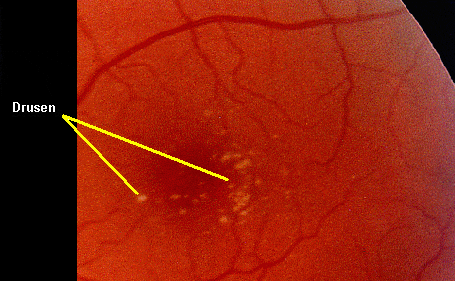
Much research is currently underway to stop or even reverse Age Related Macular Degeneration (ARMD). Of note, the "dry" form rooted in the over abundance of Macular Drusen (see photo above) that we have so far had little options to treat, is uniquely a "human disease" - meaning there are no useful animal models to help us refine these treatments, so progress has been slower than we would prefer. Many drugs are being investigated, with several unique mechanisms of action being explored. Several are in active phase 3 stages, so we may be hearing clinically useful information soon on them.
Mitochondria are a "focal point" for much of this research (see my post on statins and CoQ10 for more on how these cellular "furnaces" work to produce energy), as they play a crucial role in how the retina works. Cardiolipin works as a stabilizer of inner mitochondrial structure - something that tends to wither with age. Newer drugs have been found to help normalize this mitochondrial structure and others may help to protect the neurons that process and transport the electrical signals from the pigment bearing cells. Some overlap in what appears pivotal to Alzheimer's dementia is also implicated in some forms of ARMD and drugs being tested for Alzheimer's (preventing Amyloid Beta clusters) may also prove helpful. Anti-inflammatory medications (protective of Complement cascades) are also on the docket, while stem cell injection therapies and gene-modifying implants are also under research scrutiny.
Far “simpler” than these oral and injectable treatments, is Valeda, a Low Level Light Therapy that produces "photobiomodulation" or PBM. A German photobiologist reduced this concept to a simpler to understand relationship, for me. He pointed out that the DNA in a mitochondria is closely related to the DNA in a plant's chloroplast - the "furnace" that makes plant cell energy from the sun (by way of chlorophyll and photosynthesis). From an evolutionary standpoint, this could explain how some simple mutation(s) led from the plant life in our "primordial swamp" something like 4 billion years ago, to animal life as we now know it. Once living cells no longer depended on the sun for energy, it opened the door to legs rather than roots and we evolved from there. This might also explain how light can continue to "excite" our mitochondria and make them produce energy at a higher rate (Photobiomodulation). Certain wavelengths of light are more effective and efficient at this PBM process and because the retina is already built to be excited by light, it can also help explain how this part of our anatomy might be especially poised to benefit from PBM.
Valeda uses 3 wavelengths in a specific protocol involving the amount of each wavelength (in time and energy) exposed to the retinal cells. Each wavelength has a purpose, One is principally to increase blood flow, improving nourishment and oxegen delivery. Another two combine to stimulate energy production (ATP) and inhibit both inflammation and cell death. All of this reduces the visual waste (drusen) and can improve - and help maintain - visual acuity. It is important to note that “too much” energy can be harmful to the retina, and it is also very wavelength-specific. The “wrong” wavelength may do little good and may do more harm than good. How long the retina is exposed to this light can also play a significant role. The company responsible for Valeda worked with scientists and lab-based studies to define the optimal type, duration and energy levels of light to get a significant PBM benefit.
What does this look like from the perspective of a patient with ARMD? In a study of approximately 100 patients (LITGHTSITE III) along with other prior patient-study-supporting data (LIGHTSITE I & II), the Valeda device was used to treat dry ARMD patients with certain clinical criteria defined as mild to moderate dry AMRD (the exact determinants are well defined but go beyond the scope of this posting) – significantly in a visual range between 20/32 (good enough in the USA to pass a full day and nighttime DMV driving test if only in one otherwise healthy eye) to 20/70 (good enough in most states in the USA to pass a daytime DMV driving test if at least this good in both eyes). 99% of the patients in this study group were Caucasian with blue or brown eyes, so it has yet to be effectively studied in non-Caucasian ethnicities. It is also worth noting that since some were treated with a “sham” light source, that fewer received actual Valeda treatment - so this is a very small study by most FDA standards.
Importantly, it helped the Valeda-treated group to overall improve one line of visual acuity and largely maintain it over a 2-year interval. This required 3 sessions of 9 visits over 5 weeks, each visit exposing the study eyes to all 3 wavelengths of light at protocol intervals, energy levels and duration (about 10 minutes total time for 2 eyes), with approximately 4 months between each of the 5-week, 9 visit treatments (so about 90 total minutes of treatment over 5 weeks, repeated every 4 months). This compared favorably to the sham group who received a weaker dose of red and amber-only light therapy, with that group gaining only a few letters over the initial 1-year interval and closer to baseline (minimal measurable effect) at 2 years. Also helpful was the finding of fewer PBM/Valeda patients progressing to central Geographic Atrophy (loss of central vision that is – so far – untreatable even with injections).
One additional statistic not directly reported in the initial 2-year study, was the effect of COVID, causing a 20-month interval of study interruption (the difference between SIGHTSITE II and SIGHTSITE IIIb). Looking at this smaller reporting group after 20 months of no treatments (44 patients), the PBM/Valeda group had only lost an average of 1 letter where the Sham group had lost approximately another line (as would be expected from the age-related natural course of this disease) – indicating some lasting benefits from progression even after 20 months of no additional therapy and then gaining further benefits once treatments were re-initiated. Long-Term Performance: Looking at the total aggregate observation data spanning up to 4.5 years, more than 60% of patients who received Valeda treatments across both consecutive studies maintained a sustainable vision benefit of greater than one line (>5 letters) on the eye chart. Currently we do not have established guidelines for what treatment intervals may be required for longer term “maintenance.”
Who it is not for: Patients with wet ARMD, central-involving geographic atrophy, light sensitivity, or a history of light-triggered migraines or seizures.
My understanding is that while the FDA has approved Valeda for the indications I specified, it is still considered somewhat investigational and therefore somewhat controversial within the Retina specialty groups. Why the FDA approved it probably is largely a factor of finding no study-specific, documented harm and what appears to be good results for the majority of those treated so far. If this seems a guarded praise from me - it basically is - as it hinges on good science but a small study - though I also am aware of practices offering Valeda, who continue to monitor this PBM technology with a keen eye on risks versus benefits.
Medicare has been moving to cover patients who follow within the study-determined, clinical indications for treatment, but coverage has been variable across the country (depending on the Medicare carriers responsible for administering determinations of coverage). Non-Medicare insurance is even more variable, so check with your treating physician as to your eligibility and payment coverage. I’ve been told that most Valeda treatment sites will also accept non-insured out of pocket patient payments.
As a physician intensely interested in PBM for the many medical uses it has shown to be effective for, I will continue to follow the retinal literature as well as the longstanding dry eye-related literature and attempt to keep you updated on all things PBM-related in the years to come. I should also note that while I have many years of experience practicing Ophthalmology, I do not profess to be a retinal specialist and encourage anyone with a known retinal problem to seek consultation and if required, care from one.
To schedule an appointment with Dr. Jaccoma, call Excellent Vision at this dry eye office:
155 Griffin Rd, Portsmouth, NH 03801 (603) 574-2020
PLEASE NOTE – Excellent Vision has CLOSED its office at 3 Woodland Rd, STE 112 Stoneham, MA 02180 (near Boston) (781) 321-6463 and no longer offers any appointments there.